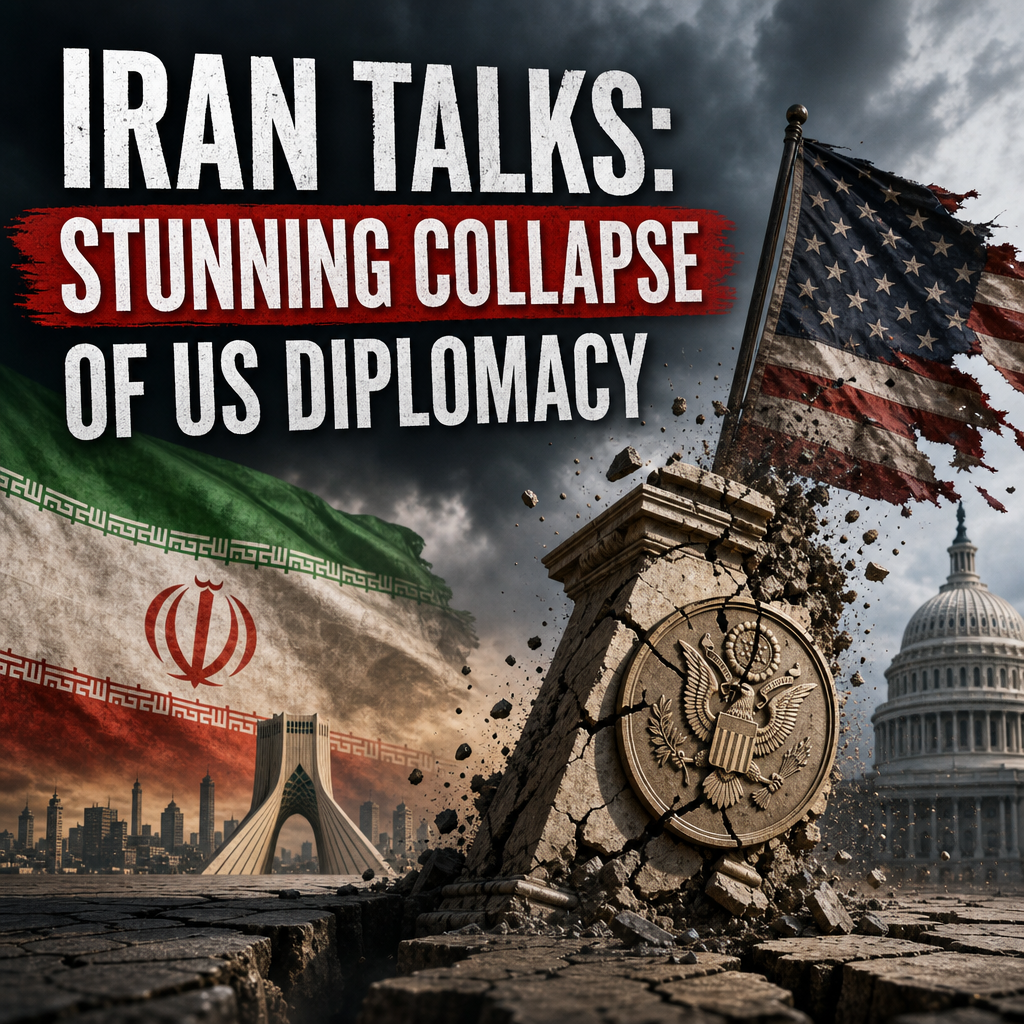
Iran Talks: Stunning Collapse of US Diplomacy


Iran talks have once again exposed how fragile diplomacy becomes when mistrust, military pressure, and domestic politics all collide.
The latest debate around negotiations with Tehran shows a familiar pattern: one side argues that diplomacy has been hollowed out by years of sanctions, escalation, and mixed signals from Washington, while others insist that Iran’s own actions have made serious engagement nearly impossible. Across reporting and commentary from Al Jazeera, Sky News, and RT, the common thread is not agreement on blame, but a shared sense that the diplomatic channel is weaker than it should be and that the risks of its failure are rising.



Iran talks and the breakdown of trust
A central theme in the coverage is that diplomacy cannot function when neither side believes the other is negotiating in good faith. Al Jazeera’s opinion perspective frames the collapse less as a single failed meeting and more as the result of a long erosion in credibility. From that angle, the problem is not only what happens at the bargaining table, but the wider environment: sanctions that remain in place, threats of escalation, and the sense in Tehran that Washington may not be able to guarantee any durable deal even if one is reached.
That argument has a real logic. In the Middle East, diplomacy often depends less on optimism than on predictable enforcement and political continuity. If one administration can reverse the commitments of another, or if a deal is seen as a prelude to pressure rather than a step toward normalization, then each round of talks starts from a lower baseline of trust.




At the same time, other coverage makes clear that this is not simply a story about U.S. inconsistency. Sky News-style reporting on the broader regional picture tends to emphasize the security concerns of Western governments and allies, particularly around Iran’s nuclear activity, missile program, and support for armed groups across the region. From that viewpoint, the breakdown is not proof that diplomacy failed in a vacuum; it is evidence that negotiators were trying to bridge a gap that had already widened because of Iran’s own strategic choices.
What the different viewpoints are saying
The strongest takeaway from the source mix is that there is no single cause of the collapse. Instead, there are competing interpretations of the same failure.
Viewpoint 1: Washington weakened diplomacy through pressure without a credible endgame
The Al Jazeera opinion approach suggests the U.S. has often demanded restraint from Iran while pairing it with coercive measures that make compromise politically toxic in Tehran. The result, in this view, is diplomacy that looks less like a path to settlement and more like a tool for delay or leverage.
This criticism is not without precedent. Many analysts have argued that maximum-pressure strategies can force short-term economic pain, but they do not necessarily produce lasting concessions. They can also strengthen hardliners who argue that the West will never offer Iran a fair deal.
Viewpoint 2: Iran’s own behavior makes talks hard to defend
Sky News reporting and broader Western commentary tend to stress that skepticism toward Iran is not manufactured out of thin air. Tehran’s nuclear advances, regional alliances, and confrontational rhetoric have made many governments doubt that negotiations would be enough on their own to stabilize the situation.
This perspective matters because diplomacy is not only about goodwill; it is about what each side believes the other can verify and enforce. If Iran expands its leverage while insisting on relief first, critics argue, then talks risk becoming a way to buy time rather than reduce danger.
Viewpoint 3: The real winner is political theater, not diplomacy
RT coverage often highlights the role of U.S. foreign policy as performance: public calls for negotiation paired with actions that keep tensions alive. From that angle, the collapse of talks is presented as evidence that Washington cannot separate diplomacy from domination. Whether one agrees with that framing or not, it captures a broader public suspicion that great-power messaging often matters more than actual compromise.
There is a useful warning in that criticism. Even when it overstates the case, it reminds readers that diplomacy can fail not just because one side is unwilling, but because each side is signaling to domestic audiences first and negotiating second.
Why the collapse matters beyond the headlines
The practical danger is that failed Iran talks do not stay confined to one issue. They can affect oil markets, regional military posture, nuclear proliferation risks, and the stability of neighboring states. Even a temporary deadlock can produce real consequences if both sides conclude that time is on their side.
A few realities stand out:
– Escalation becomes easier than compromise when military deterrence substitutes for political progress.
– Sanctions alone rarely resolve strategic disputes, especially when the targeted state can rally nationalism around them.
– Regional actors are not passive bystanders; Israel, Gulf states, and armed groups all influence how much room negotiators actually have.
– Public messaging often hardens positions, especially when leaders need to appear strong at home.
That does not mean talks are pointless. It means they are usually the least bad option available in a situation where the alternatives are worse.
The bigger lesson from Iran talks
The most honest conclusion is also the least satisfying one: the collapse of diplomacy around Iran is not simply the failure of one side, and it is not proof that diplomacy itself is dead. It is evidence that diplomacy is being asked to do too much in an atmosphere of zero trust, shifting red lines, and competing narratives about who is responsible.
Al Jazeera’s critique is persuasive when it argues that pressure without credibility is not a strategy. Sky News’ framing is persuasive when it notes that concerns about Iran’s behavior are not imaginary and cannot be waved away. RT’s skepticism resonates insofar as U.S. diplomacy often appears tangled in coercion and messaging. Put together, these views suggest a sobering truth: there is still a diplomatic path, but it is narrower than ever.
If Iran talks are to mean anything in the future, both sides will need more than talking points. They will need restraint, verification, and a willingness to accept a deal that solves problems imperfectly rather than chasing total victory. In the current climate, that may be the hardest bargain of all.